Sep
Vape Guides
Freebase vs Salt Nicotine: Coil, Wattage & PG/VG Guide
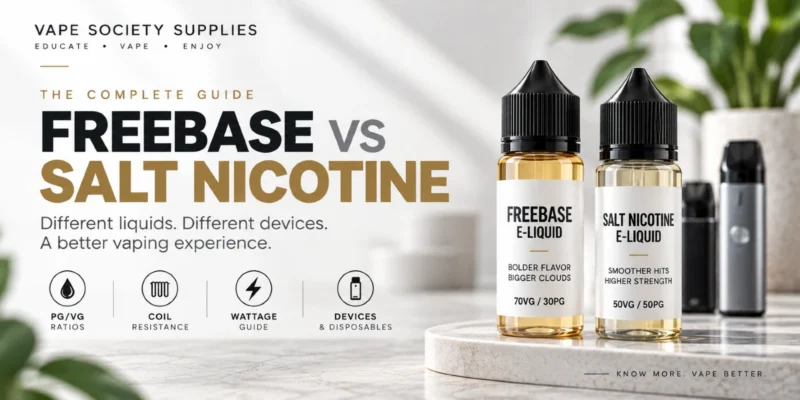
Choosing between freebase e-liquid and nicotine salt involves more than deciding how much nicotine you want. Your e-liquid’s nicotine strength, PG/VG ratio, coil resistance, wattage, airflow and device all work together. That is why the exact same e-liquid can taste stronger, warmer, cooler or noticeably different when moved from one vape to another.
It is also one reason someone may enjoy the flavor from a disposable but find that the bottled version of a similar e-liquid does not taste quite the same in a refillable pod.
In this guide, we explain freebase vs salt nicotine, what is inside vape juice, PG/VG ratios, coil resistance, wattage, compatible devices and what different power levels generally feel like. We also look separately at disposable vape technology and how it evolved from simple single-coil devices into rechargeable mesh and multi-coil systems—and eventually into reusable batteries paired with replaceable prefilled pods.
Quick rule: Do not choose an e-liquid based on coil resistance alone. Match the nicotine strength and PG/VG ratio to the device and coil, and always follow the coil manufacturer’s recommended wattage range.
Freebase vs Salt Nicotine at a Glance
Quick Answer
Freebase nicotine delivers a stronger throat hit and is commonly used at lower nicotine strengths, making it well suited for higher-power and sub-ohm devices.
Nicotine salts provide a smoother inhale at higher nicotine strengths and are generally better suited for lower-power pod systems.
| CATEGORY | FREEBASE E-LIQUID | NICOTINE SALT E-LIQUID |
|---|---|---|
| Nicotine form | Freebase nicotine | Protonated nicotine |
| Common nicotine level | Generally lower | Generally higher |
| Common PG/VG | Often 70VG/30PG for sub-ohm liquids | Often 50VG/50PG |
| Typical device | Pods, pod mods and tanks | Low-power pod systems |
| Typical draw | MTL, RDL or DTL | Primarily MTL/RDL |
| Common coil range | Broad; often about 0.15–1.2Ω depending on application | Often about 0.6–1.2Ω for traditional salts |
| Power | Low through very high | Usually low to moderate |
| Vapor production | Can be very high | Usually lower |
These are general guidelines, not universal specifications. Modern devices increasingly blur the traditional boundaries between these categories.
In This Guide
What Is Freebase Nicotine?
Freebase nicotine is the traditional form of nicotine used in e-liquid. It is commonly sold in lower nicotine strengths such as 0mg, 3mg, 6mg and 12mg, although other strengths are available.
Lower-strength freebase liquids are especially common in sub-ohm vaping because low-resistance, higher-powered coils can vaporize substantially more e-liquid with each puff than a small MTL pod. Because more liquid is being vaporized, the nicotine concentration is usually lower.
Freebase is commonly associated with sub-ohm tanks, pod mods, RDL devices, DTL devices and larger mesh coils, but it is not limited to high-powered devices. Suitable freebase liquids can also be used in higher-resistance pods when the liquid viscosity, nicotine strength and manufacturer specifications are appropriate.What Is Nicotine Salt?
Nicotine salt, usually shortened to salt nic, is nicotine formulated in a protonated form. Despite the name, it does not mean ordinary table salt has been added to your e-liquid.
Commercial nicotine-salt formulations use organic acids to alter nicotine chemistry. Depending on the formulation, manufacturers may use acids such as benzoic, lactic or levulinic acid. The exact formulation varies by manufacturer.
Nicotine salts became especially popular because they can be formulated at higher nicotine concentrations for compact, lower-powered devices. Common strengths include 20mg, 25mg, 30mg, 35mg and 50mg, although exact strengths vary by brand and market.
What Is Actually in Vape Juice?
Propylene Glycol (PG)
Propylene glycol is a relatively thin carrier liquid used in many e-liquids. It helps carry nicotine and flavoring and generally produces a more pronounced throat sensation than VG.
More PG generally means: thinner liquid, less dense vapor and a more pronounced throat sensation.
Vegetable Glycerin (VG)
Vegetable glycerin is much thicker than PG and is especially important for vapor production.
More VG generally means: thicker liquid, denser vapor and a softer throat sensation.
Flavorings
Flavor concentrates create the flavor profile of the e-liquid. A finished liquid can combine numerous flavoring compounds to create profiles such as fruit, dessert, tobacco, mint or coffee.
Nicotine
Nicotine-containing e-liquid generally uses either freebase nicotine or nicotine in a protonated/salt formulation. Nicotine-free e-liquids are also available.
PG vs VG: What Does the Ratio Mean?
E-liquid bottles often list ratios such as 50VG/50PG, 60VG/40PG or 70VG/30PG. These numbers describe the approximate proportion of vegetable glycerin to propylene glycol.
50VG / 50PG
A 50/50 liquid is relatively thin and is common among nicotine salts. It generally works well with smaller wicking systems and higher-resistance pods designed for this viscosity.
Generally suited for: MTL pods, salt nicotine and smaller pod coils.
60VG / 40PG
This is a middle ground that can provide greater vapor density than 50/50 while remaining compatible with many modern pod systems.
Generally suited for: modern pods, RDL systems and some freebase liquids.
70VG / 30PG
70VG/30PG is very common in lower-strength freebase e-liquid intended for larger coils. The thicker liquid pairs naturally with coils that have sufficient wicking capacity.
Generally suited for: sub-ohm tanks, larger mesh coils, DTL devices and pod mods.
Why PG/VG Matters to Your Coil
Your coil contains wicking material that must continuously pull fresh e-liquid toward the heating element.
If the liquid is too thick for the pod, it may not replenish the wick quickly enough, which can contribute to poor flavor or dry hits. If the liquid is too thin for a system designed around thicker liquids, it may be more susceptible to leaking or flooding.
The better question is not simply “Will this liquid fit in my pod?” but rather: “Was this liquid formulated for the type of coil I am using?”
What Coil Resistance Should You Use for Salt Nicotine?
Device compatibility matters: Coil resistance alone does not determine whether an e-liquid is appropriate. Nicotine strength, PG/VG ratio, wattage, airflow and the manufacturer’s specifications should all be considered together.
There is no single universal “salt nic coil.” Traditional higher-strength nicotine salts are generally paired with higher-resistance, lower-output pods.
1.0Ω–1.2Ω
This is classic MTL salt-nic territory. You can generally expect cooler vapor, a tighter draw, lower vapor production, lower e-liquid consumption and lower power requirements.
0.8Ω
0.8Ω is one of the most versatile resistance options in modern pod systems. Compared with 1.0Ω–1.2Ω, it generally produces more vapor, slightly warmer vapor, stronger flavor intensity and a somewhat more open draw.
0.6Ω
At 0.6Ω, many modern pod systems produce noticeably more aerosol. Expect warmer vapor, greater airflow, more vapor, higher liquid consumption and stronger flavor intensity. Nicotine concentration becomes increasingly important as vapor production increases.
Below 0.6Ω
Below 0.6Ω generally moves toward higher-output vaping. We generally would not recommend pairing very high-strength nicotine salt, such as 50mg, with a high-powered, very low-resistance configuration because increased vapor production can substantially change nicotine delivery per puff.
What Coil Resistance Should You Use for Freebase?
0.8Ω–1.2Ω
Higher-resistance pods can work with suitable freebase liquids and generally provide a tighter, lower-output experience.
0.6Ω–0.8Ω
This is a versatile modern pod range and can work well for people who want more flavor and vapor than a traditional MTL pod without moving to a large sub-ohm tank.
0.3Ω–0.6Ω
This range moves into RDL and sub-ohm territory. Lower-strength freebase liquids become increasingly appropriate as output rises.
0.15Ω–0.3Ω
This is typical high-output sub-ohm territory and is generally paired with low-strength nicotine, high-VG freebase liquid, greater airflow and higher wattage.
Coil Resistance vs Wattage: They Are Not the Same Thing
A common mistake is assuming “0.8Ω = one exact wattage.” It does not work that way.
Two coils with the same resistance can have different recommended wattages because manufacturers also change mesh surface area, coil material, wicking, airflow and coil geometry.
The wattage printed on the coil or specified by its manufacturer always takes priority over a generic resistance chart.
What Does Different Vape Wattage Feel Like?
| POWER | GENERAL FEEL | TYPICAL APPLICATION |
|---|---|---|
| 8–12W | Cool, tight, low vapor | High-resistance MTL |
| 12–18W | Cool-to-warm, moderate vapor | MTL / many salt setups |
| 18–25W | Warmer, fuller vapor | Modern pods / RDL |
| 25–40W | Warm, greater vapor | RDL / lower-strength freebase |
| 40–60W | Warm, high vapor production | Sub-ohm freebase |
| 60W+ | High-output, potentially hotter vapor | Low-resistance DTL |
Airflow matters tremendously. A well-ventilated coil running at higher wattage can sometimes feel cooler than a lower-powered coil with much more restricted airflow.
Does Higher Wattage Mean Better Flavor?
No. Every coil has a range where it was designed to operate.
Too little power can result in weak vapor, muted flavor or poor coil performance. Too much power can cause excessive heat, dry hits, burnt wick or shortened coil life.
Within the manufacturer’s recommended range, start toward the lower end and gradually increase power until you find the balance of warmth, flavor and vapor you prefer.
Recommended Devices for Salt Nicotine
Modern refillable pod systems are useful because the same device platform can often support several pod resistances.
Vaporesso XROS Series
The Vaporesso XROS platform offers multiple pod resistances that cover MTL through higher-output pod vaping. For traditional salt nicotine, 0.8Ω–1.2Ω is a sensible general starting range, adjusted for nicotine concentration and preferred draw.
View manufacturer specifications.
OXVA XLIM 3 Ultra
The OXVA XLIM 3 Ultra supports multiple cartridge resistances, including 0.4Ω, 0.6Ω, 0.8Ω and 1.2Ω options. For traditional higher-strength salt nic, we would generally begin with 0.8Ω or 1.2Ω, while lower-resistance cartridges provide progressively greater output.
View manufacturer specifications.
Recommended Devices for Freebase E-Liquid
Freebase gives you considerably more choice. A modern refillable pod can provide a good lower-output freebase experience, while a pod mod or tank can deliver dramatically greater vapor production.
Lower-Power Freebase
Systems such as the XROS and XLIM families can work with appropriately formulated freebase liquids and compatible pods. Roughly 0.6Ω–1.0Ω provides considerable flexibility for pod-style freebase vaping.
Higher-Power Freebase
For high-VG, low-strength freebase, move toward a device designed specifically for higher output, such as a compatible pod-mod or tank system. The Vaporesso LUXE XR MAX 2, for example, supports both low-resistance DTL and higher-resistance MTL configurations, illustrating how dramatically one platform can change simply by changing the coil and pod setup.
Why Does Salt Nic Sometimes Taste Better in a Disposable?
A common customer question is: “Why doesn’t my bottled salt nic taste as good as a disposable?”
It may have nothing to do with the quality of the liquid. The disposable manufacturer has already selected and tuned the e-liquid formulation, coil design, mesh surface area, power delivery, airflow and wicking system around that particular device.
With a refillable pod, you are choosing many of those variables yourself. A relatively cool 1.2Ω pod can make the same general flavor profile feel very different from a modern disposable using a more aggressive mesh configuration.
Moving to an appropriate 0.8Ω or 0.6Ω pod may create a warmer and more vapor-dense experience, but nicotine concentration must also be appropriate for the increased output.
Disposable Vapes Use a Different Approach
A disposable is essentially a preconfigured vaping system. Instead of asking the consumer to match liquid, coil, wattage and airflow, the manufacturer chooses those components during product development.
The consumer receives the battery, electronics, coil, wick, airflow system and prefilled e-liquid already configured to work together.
How Disposable Vape Coils Evolved
1. Basic Single-Coil Disposables
Early designs were relatively simple: a small battery, draw sensor, heating coil and prefilled liquid. When the battery or liquid was depleted, the complete device was discarded.
2. Mesh-Coil Disposables
Mesh technology became increasingly common. Instead of relying only on a traditional small wire coil, mesh provides a broader heating surface and allows manufacturers to pursue more consistent vaporization across the wick.
3. Rechargeable Disposables
As liquid capacities increased, manufacturers began adding USB-rechargeable batteries so the battery could be charged multiple times before the prefilled liquid was depleted.
4. Dual-Mesh and Multi-Coil Systems
Newer devices began using dual mesh, multiple heating elements, alternating coils and selectable output modes. Depending on the design, one mode may prioritize efficiency while another provides greater output.
5. Screens and Adjustable Modes
Modern disposable-style devices increasingly added features once associated mainly with reusable devices, including battery indicators, e-liquid indicators, displays, adjustable airflow and multiple power modes.
The Next Step: Reusable Batteries + Replaceable Prefilled Pods
One of the newer developments separates the part that needs to be replaced from the part that can be reused.
Instead of discarding the battery, electronics, coil and liquid together, some systems use a reusable rechargeable battery paired with a replaceable prefilled pod.
The pod contains the e-liquid and heating system. When it is empty, the user replaces the prefilled pod while keeping the battery. This creates a middle ground between a traditional disposable and a refillable pod system.
The user still gets the convenience of no bottled e-liquid, no manual refilling and no separate coil installation, while the battery and electronics can be reused.
What Coil Resistance Do Disposable Vapes Use?
There is no universal disposable-vape resistance.
Depending on the model, a disposable may use a traditional wire coil, single mesh, dual mesh, multiple heating elements or a proprietary coil system. Manufacturers do not always publish resistance because the consumer is not normally expected to select the coil or manually set the wattage.
Do not buy a refillable pod simply because it has the same resistance as your favorite disposable. Resistance is only one variable. Mesh geometry, power delivery, airflow, liquid composition and wick design can make two coils with identical resistance perform very differently.
Freebase vs Salt Nic: Which Setup Should You Choose?
Higher-Strength Nicotine Salt
Start with a higher-resistance, lower-powered MTL pod, commonly around 0.8Ω–1.2Ω.
Lower-Strength Nicotine Salt
Depending on the manufacturer and nicotine concentration, 0.6Ω–0.8Ω can provide a warmer, more vapor-dense experience.
Freebase in a Pod
Suitable freebase liquids can work around 0.6Ω–1.0Ω, depending on nicotine strength, PG/VG ratio and the manufacturer’s recommendations.
High-VG, Low-Nicotine Freebase
Move toward lower resistance, a larger wicking system, greater airflow and higher power using a coil designed specifically for that purpose.
The Vape Society Rule: Match the Whole Setup
Nicotine Strength → PG/VG → Coil → Wattage → Airflow
All five affect the vaping experience. A customer asking “What is the best coil for salt nic?” is still missing one important piece of information: What strength salt nic are you using?
Likewise, someone asking “Can I use freebase in this pod?” should also consider the PG/VG ratio and nicotine concentration. Matching the entire setup is much more useful than chasing one particular resistance number.
Freebase vs Salt Nic: The Bottom Line
The main difference between freebase nicotine and nicotine salts comes down to nicotine concentration, throat sensation and the type of device they are commonly paired with. Freebase nicotine is generally associated with lower nicotine strengths and can accommodate everything from pod systems to high-output sub-ohm devices, while nicotine salts are commonly used at higher concentrations in lower-power pod systems. In either case, nicotine strength, PG/VG ratio, coil, wattage and airflow should be considered together.
Frequently Asked Questions
Is 0.8 ohm good for salt nic?
Yes. 0.8Ω is one of the most versatile resistance levels for modern salt-nic pod systems and provides a useful balance between flavor, warmth and vapor production.
Is 1.2 ohm good for salt nicotine?
Yes. A 1.2Ω pod generally provides a cooler, tighter and lower-output experience that can be particularly appropriate for higher-strength salt nicotine.
Can I use 0.6 ohm with salt nic?
Potentially, yes. A 0.6Ω pod generally produces more aerosol than higher-resistance pods, so nicotine concentration and manufacturer recommendations become especially important.
What coil should I use for 50mg salt nic?
For high-strength salt nicotine such as 50mg, we generally favor a higher-resistance, lower-output MTL setup rather than a low-resistance, high-powered coil. Always check the liquid and device manufacturer’s recommendations.
Can you use freebase vape juice in a pod?
Yes. Many modern pod systems can use appropriate freebase e-liquids. Match the nicotine strength and PG/VG ratio to the pod and manufacturer specifications.
Is 70VG/30PG good for salt nic pods?
It depends on the pod. High-VG liquid is thicker than 50/50 and may not wick properly in small pods designed for thinner liquid. Check the manufacturer’s recommendations.
Does a lower-ohm coil give more flavor?
Not automatically. Lower resistance often allows greater power and vapor production, but coil design, mesh surface area, airflow, liquid and wattage all affect flavor.
Why does my vape juice taste different in different devices?
Different devices vaporize the same liquid at different temperatures, airflow rates and output levels. Coil material, mesh design and wicking can also change the perceived flavor.
Important: The resistance and wattage ranges in this guide are general educational guidelines. Always follow the recommended resistance, e-liquid compatibility and wattage range provided by the manufacturer of your device, pod or coil.