

Sep
Vaping 101 Guides
Freebase vs Salt Nicotine: Strength, Coils and Wattage Guide
Freebase vs salt nicotine comes down to strength, smoothness and the device you use. Nicotine salt stays smooth at high strengths, so it suits small pod kits, while freebase e-liquid usually comes in low strengths for kits that make more vapor. Whichever you pick, your nicotine strength, coil resistance and wattage also need to match.
Updated October 11, 2026
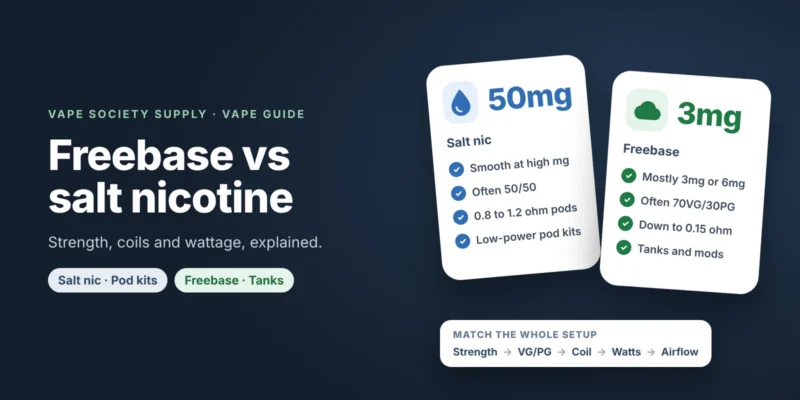
On our own shelves, nearly all the salt nic comes in 24mg to 50mg, with 50mg the most common strength, while most of our freebase flavors come in 3mg or 6mg.
The short version
- Nicotine salt: smooth at high strengths, so it’s made for low-power pod kits and a tight MTL draw.
- Freebase e-liquid: usually 3mg or 6mg, for pod mods, box mods and tanks that make more vapor.
- VG/PG: salt nic is often 50/50, while sub-ohm freebase is often 70VG/30PG.
- Coils: salt nic usually goes in a 0.8 to 1.2 ohm pod, while freebase runs from about 0.15 ohm up.
- The rule: match nicotine strength, VG/PG, coil and wattage, and stay inside the watt range printed on your coil.
Freebase vs salt nicotine at a glance
The table compares freebase vs salt nicotine side by side. These are common ranges rather than hard rules, since newer kits blur the lines.
| What to compare | Freebase | Salt nic |
|---|---|---|
| Nicotine form | Freebase | Mixed with an acid |
| Strengths we stock most | 3mg and 6mg | 24mg to 50mg |
| Common VG/PG | Often 70VG/30PG | Often 50/50 |
| Typical device | Pod mods, box mods, tanks and some pods | Low-power pod kits |
| Typical draw | MTL, RDL or DTL | Mostly MTL, some RDL |
| Common coil range | About 0.15 to 1.2 ohm | About 0.6 to 1.2 ohm |
| Power | Low to very high | Low to moderate |
What is freebase nicotine?
Freebase nicotine is the classic form of nicotine in e-liquid, but it feels harsh on the throat at high strengths. For that reason, freebase e-liquid usually comes in low strengths, and most of our freebase flavors are 3mg or 6mg.
Low-strength freebase e-liquid suits high-power kits, because a sub-ohm coil turns far more e-liquid into vapor per puff than a small pod does. It’s the usual pick for sub-ohm tanks, box mods and DTL vaping, though it works in many pods too, as long as the strength and VG/PG suit the coil.
What is nicotine salt?
Nicotine salt, or salt nic, is nicotine mixed with an acid, and despite the name it has nothing to do with table salt. When researchers tested 23 salt nic e-liquids, lactic acid turned up most often, followed by benzoic and levulinic acid (Nicotine & Tobacco Research).
The acid makes the nicotine less alkaline, which the researchers note may make it less harsh. Because of that, salt nic can come in high strengths that still feel smooth in a small, low-power pod kit. It’s also why nearly all the salt nic we stock comes in 24mg to 50mg.
Our best-selling salt nic and freebase e-liquid
Want to try each type? These are the two we sell the most of, and both are in stock in the strengths shown.

Strawberry POM NKD 100 Salt 30ml
Kiwi, strawberry and pomegranate with a cool menthol finish, by Naked 100. It’s the salt nic we sell the most of: 2,300+ customers have bought it, and about 1 in 6 came back for more.
Best for: pod kits, if you like a cool finish.
Good to know: It has menthol, so skip it if you don’t want cooling.
A warm glazed donut with a hint of cinnamon, by Loaded. It’s the best seller in our whole store: 17,000+ customers have bought it, and nearly 1 in 4 came back for more.
Best for: sub-ohm tanks and pod mods with low-ohm coils.
Good to know: The 120ml bottle is big, so it’s a lot to buy if you only want to try it.
How to pick a nicotine strength
Nicotine strength is where freebase vs salt nicotine differs most. Start with your device, since it decides how much vapor each puff makes. A low-power pod makes a small puff, so it pairs with higher-strength salt nic. A sub-ohm tank makes a big puff, so it pairs with 3mg or 6mg freebase e-liquid.
After that, think about how strong you want each puff to feel. If a puff feels too strong, step down a strength or use a lower-power setup. Our top-selling salt nic comes in 35mg as well as 50mg, for example. Our guide to the negative effects of vaping lists the signs of too much nicotine.
PG and VG: what the ratio means
VG/PG is the next big freebase vs salt nicotine difference. E-liquid bottles list a VG/PG ratio, such as 50/50 or 70/30. VG is thick and makes dense vapor, while PG is thin and adds more throat feel. The common ratios line up like this:
- 50VG/50PG: thinner and common in salt nic. It’s made for small MTL pods.
- 60VG/40PG: a middle ground that many newer pods can wick.
- 70VG/30PG: thicker and common in low-strength freebase for sub-ohm coils.
The ratio matters because your coil’s wick has to keep up. Thick e-liquid can wick too slowly in a small pod and cause dry hits, while thin e-liquid can leak from a coil made for thick juice. Our PG and VG guide explains it in detail.
Coil resistance for salts
There’s no single salt nic coil, but coil resistance still matters, since higher-strength salts usually go in higher-resistance, lower-power pods. Each range feels different:
- 1.0 to 1.2 ohm: the classic MTL range. Expect cooler vapor, a tight draw and less e-liquid used than with lower-resistance coils.
- 0.8 ohm: one of the most flexible pod options. It gives warmer vapor and fuller flavor than 1.2 ohm, with a slightly looser draw.
- 0.6 ohm: more vapor and warmth, and it uses more e-liquid, so a lower salt strength often fits it better.
- Below 0.6 ohm: high-output territory. We don’t suggest 50mg salt nic here, because each puff makes much more vapor.
Coil resistance for freebase
Freebase e-liquid gives you more room, from a pod all the way up to a big tank. Here’s what each coil resistance range is like:
- At 0.8 to 1.2 ohm: it works with a suitable freebase e-liquid in a pod, with a tighter, lower-output draw.
- From 0.6 to 0.8 ohm: a flexible pod range, with more flavor and vapor than an MTL pod.
- Between 0.3 and 0.6 ohm: RDL and sub-ohm territory, so lower strengths fit better.
- Down at 0.15 to 0.3 ohm: high-output sub-ohm vaping, with 3mg or 6mg high-VG freebase, open airflow and higher watts.
Coil resistance vs wattage
Coil resistance and wattage aren’t the same thing. Two 0.8 ohm coils can have different watt ranges, because their mesh, wick and airflow differ. When in doubt, go by the watt range printed on your coil, not a general chart.
This is roughly how each power range feels:
| Power | How it feels | Typical use |
|---|---|---|
| 8 to 12W | Cool, tight, little vapor | High-resistance MTL pods |
| 12 to 18W | Cool to warm, some vapor | Most salt nic pods |
| 18 to 25W | Warmer, fuller vapor | Newer pods and RDL |
| 25 to 40W | Warm, more vapor | RDL and low-strength freebase |
| 40 to 60W | Warm, lots of vapor | Sub-ohm freebase |
| 60W and up | High output, can run hot | Low-resistance DTL |
Does more power mean better flavor? Not always. Too little power gives weak vapor, while too much can burn the wick. Start near the low end of your coil’s range, then raise it slowly until it tastes right. Airflow matters too: an open coil at higher watts can feel cooler than a tight one at lower watts.
Which device to use
The freebase vs salt nicotine choice often comes down to your device. For salt nic, pick a refillable pod kit that takes 0.8 to 1.2 ohm pods. Our starter kit guide covers our best sellers as well as our newest pod kits. For newer slim kits, see our XROS 6 vs Caliburn G5 and XLIM Pro 3 vs XLIM 3 Ultra guides.
For freebase e-liquid, you have more choice. A pod kit with 0.6 to 1.0 ohm pods works for a gentler vape, while a pod mod or box mod makes far more vapor, as our DRAG S3 review and Nord 6 review show. For tanks and coils, our sub-ohm vaping guide explains the basics.
Bottled salt nic vs prefilled pods and disposables
Salt nic comes in bottles, prefilled pods and disposables, and each one suits a different vaper:
- Ready to use: prefilled pods and disposables need no filling. Bottles mean you refill by hand, but you control how much goes in.
- Choice: bottles usually come in more flavors and strengths. They also work in any refillable pod that suits them, while a prefilled pod only fits its own device.
- Cost: to compare, divide the price by the mL you get.
- Waste: a refillable kit keeps its battery, while a disposable’s battery goes out with it when it’s empty.
Why salt nic can taste different in a disposable
A common question is why bottled salt nic doesn’t taste like a disposable. Often the e-liquid isn’t the problem, since the disposable’s maker tuned the coil, power, airflow and e-liquid together for that one device.
With a refillable pod, though, you choose those parts yourself. A cool 1.2 ohm pod can make the same flavor feel thinner than a disposable’s mesh coil does. For a warmer, fuller hit, try a 0.8 or 0.6 ohm pod, and lower the strength if you need to.
Disposables have changed a lot too. They started with a simple coil, then added mesh coils, rechargeable batteries, dual mesh and screens with power modes. Now some kits keep the battery and swap only a prefilled pod, which sits between a disposable and a refillable pod kit. Makers rarely list a disposable’s coil resistance, so don’t pick a pod by resistance alone.
Why freebase suits dripping better than salt nic
Dripping means dropping e-liquid straight onto the coil of a rebuildable dripping atomizer (RDA), then vaping it right away. You refill every few puffs, so it takes more work than a tank. Since an RDA makes big clouds, it pairs with high-VG, low-strength freebase e-liquid rather than high-strength salt nic.
Freebase vs salt nicotine: which setup to choose
Use this as a starting point for each type of e-liquid:
| Your e-liquid | Pod or coil | Power |
|---|---|---|
| Higher-strength salt nic (35mg to 50mg) | 0.8 to 1.2 ohm MTL pod | Low |
| Lower-strength salt nic (20mg to 30mg) | 0.6 to 0.8 ohm pod | Low to moderate |
| Freebase in a pod | 0.6 to 1.0 ohm pod | Moderate |
| High-VG freebase (3mg or 6mg) | Sub-ohm coil with open airflow | Higher |
The freebase vs salt nicotine question is really about the whole setup. Match it in order: nicotine strength first, then VG/PG, the coil, wattage and airflow. The best coil resistance for salt nic, for example, depends on whether yours is 25mg or 50mg.
Freebase vs salt nicotine FAQ
Is salt nic stronger than freebase?
Not by itself, since the mg number sets the strength, but salt nic usually comes in higher strengths. Most of the salt nic we stock is 24mg to 50mg, while most of our freebase is 3mg or 6mg.
Can you use freebase instead of salt nic in a pod?
Yes. Many pod kits work with freebase, as long as the strength and VG/PG suit the pod, so check the range your pod’s maker recommends.
Can you use salt nic in a sub-ohm tank?
We don’t suggest it. A sub-ohm coil makes much more vapor per puff, so high-strength salt nic would deliver far more nicotine. Use 3mg or 6mg freebase instead.
Is 0.8 ohm good for salt nic?
Yes, it’s one of the most flexible pod resistances, with a good balance of flavor, warmth and vapor.
What coil should I use for 50mg salt nic?
Use a higher-resistance MTL pod, around 0.8 to 1.2 ohm, at low power, and check your pod maker’s range too.
Is 70VG/30PG good for salt nic pods?
It depends on the pod. Thick e-liquid may not wick well in a small pod made for 50/50, so check what your pod’s maker suggests.
Why does my e-liquid taste different in different devices?
Each device heats e-liquid in its own way, so the coil, power and airflow all change the flavor, even with the same bottle.
Ready to pick your e-liquid?
Shop salts for pod kits, or browse every flavor we carry for bigger kits and tanks.
Strength shares come from the e-liquids in stock on the date above. Best sellers are ranked by units sold over the full history of our store, with customer counts rounded down. The coil and wattage ranges are general guides, so always follow the range your device, pod or coil maker gives. Nicotine is addictive. You must be 21 or older to buy vape products, under the federal Tobacco 21 law.